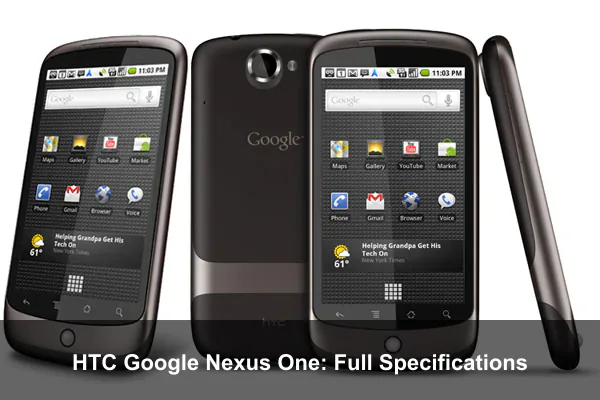
The HTC Google Nexus One is a landmark Android phone from January 2010, known for pairing a compact body with an AMOLED display and the classic hardware trackball.
For today’s readers, the useful angle is not flagship competition but legacy value: how this device compares with modern budget phones for real-world basics, collecting, and retro Android use.
Full Specifications
Network
| Technology |
GSM / HSPA |
| 2G bands |
GSM 850 / 900 / 1800 / 1900 |
| 3G bands |
HSDPA 900 / 1700 / 2100 |
|
HSDPA 850 / 1900 / 2100 – for AT&T, Rogers Wireless |
| Speed |
HSPA 7.2/2 Mbps |
Launch
| Announced |
2010, January. Released 2010, January |
| Status |
Discontinued |
Body
| Dimensions |
119 x 59.8 x 11.5 mm (4.69 x 2.35 x 0.45 in) |
| Weight |
130 g (4.59 oz) |
| SIM |
Mini-SIM |
|
Trackball |
Display
| Type |
AMOLED |
| Size |
3.7 inches, 39.0 cm2 (~54.8% screen-to-body ratio) |
| Resolution |
480 x 800 pixels, 5:3 ratio (~252 ppi density) |
Platform
| OS |
Android 2.1 (Eclair), upgradable to 2.3.6 (Gingerbread) |
| Chipset |
Qualcomm QSD8250 Snapdragon S1 |
| CPU |
1.0 GHz Scorpion |
| GPU |
Adreno 200 |
Memory
| Card slot |
microSDHC (dedicated slot), 4 GB included |
| Internal |
512MB RAM, 512MB |
Main Camera
| Single |
5 MP, AF |
| Features |
LED flash |
| Video |
480p@24fps |
Selfie camera
Sound
| Loudspeaker |
Yes |
| 3.5mm jack |
Yes |
Comms
| WLAN |
Wi-Fi 802.11 a/b/g |
| Bluetooth |
2.1, A2DP |
| Positioning |
GPS, A-GPS |
| Radio |
Factory locked by default, can be enabled |
| USB |
microUSB 2.0 |
Features
| Sensors |
Accelerometer, proximity, compass |
| Browser |
HTML |
|
Dedicated search key MP3/eAAC+/WAV player MP4/H.264 player Voice memo Predictive text input |
Battery
| Type |
Removable Li-Ion 1400 mAh battery |
| Stand-by |
Up to 290 h (2G) / Up to 250 h (3G) |
| Talk time |
Up to 10 hours (2G) / Up to 7 hours (3G) |
| Music play |
Up to 20 hours |
Misc
| Colors |
Brown (teflon coating) |
| SAR |
0.37 W/kg (head) 0.74 W/kg (body) |
| Price |
About 120 EUR |
Our Tests
| Camera |
Photo |
| Loudspeaker |
Voice 69dB / Noise 66dB / Ring 79dB |
| Audio quality |
Noise -86.1dB / Crosstalk -85.2dB |
Price and Availability
The HTC Google Nexus One offers a compelling combination of features and performance. While the base price is around €120, the actual cost may vary depending on your location and retailer. Below, you’ll find the approximate price of the HTC Google Nexus One converted into various currencies. Please note that these are estimates based on recent exchange rates as of March 24, 2026 and may not reflect the exact price you’ll find at a retailer.
- United States: $139
- Japan: ¥22,070
- United Kingdom: £104
- Australia: A$199
- Canada: C$191
- Taiwan: NT$4,437
- Denmark: kr896
- Saudi Arabia: ﷼522
- South Korea: ₩207,580
- Germany: €120
- Brazil: R$731
- Vietnam: ₫3.602.639
- Kenya: KSh 17,941
- India: ₹12,968
- Indonesia: Rp 2.352.562
- Nigeria: ₦187,264
- Pakistan: ₨38,810
- Philippines: ₱8,318
- Bangladesh: ৳১৬,৯৪৯
Value in 2026
The Nexus One is best judged as a historical Android reference device, not a primary smartphone. Its value is strongest for collectors, developers testing legacy Android behavior, or users who want a simple backup phone for calls and light messaging on compatible networks.
Design and In-Hand Feel
At 130 g with a 3.7-inch form factor, it feels far smaller and lighter than most current phones. The curved shape and Teflon-coated brown finish still look distinctive, while the trackball gives navigation feedback that modern touch-only devices do not offer.
Display Quality
The AMOLED panel delivers the deep contrast expected from early OLED-era phones, but the 480 x 800 resolution and smaller size are clearly dated next to modern high-refresh, high-brightness displays. For text and basic UI, it remains usable; for media-heavy use, it feels limited.
Performance for Basic Tasks
With a 1.0 GHz Snapdragon S1, Adreno 200 GPU, and 512MB RAM, performance is suitable only for light legacy workloads. Compared with even entry-level recent chipsets, app launch times, multitasking, and web responsiveness are in a different class.
Camera Expectations
The 5 MP rear camera with autofocus and LED flash can still capture usable daylight documentation shots, but video is limited to 480p at 24fps and there is no selfie camera. It is functional for record-keeping, not for modern social content quality.
Battery and Power Management
The removable 1400 mAh battery is a practical advantage for long-term ownership because replacements are possible. Endurance is acceptable for light use, but age of original cells and older radio efficiency mean real results depend heavily on battery condition and network signal.
Software and App Reality
Android 2.1, upgradable to 2.3.6, is the biggest limitation today. Most current apps and security expectations have moved far beyond Gingerbread-era support, so the Nexus One works best for offline tools, basic media playback, voice memos, and retro Android exploration.
Connectivity and Daily Compatibility
This is a GSM/HSPA device with no LTE or 5G, so carrier compatibility is the first check before buying. Wi-Fi, Bluetooth 2.1, GPS/A-GPS, microUSB, 3.5 mm audio jack, and expandable storage still make it flexible for old-school portable media and utility roles.
Who Should Buy HTC Google Nexus One?
Buy it if you want a milestone Android device, a collector piece, or a secondary phone for very basic tasks on supported networks. Skip it if you need modern app support, strong camera output, or reliable daily-driver performance.
Conclusion
The HTC Google Nexus One remains a significant piece of Android history with a compact design and still-usable core phone features, but its aging software and network limits make it a niche choice. Recommended mainly for collectors and retro users, not for mainstream daily use.