
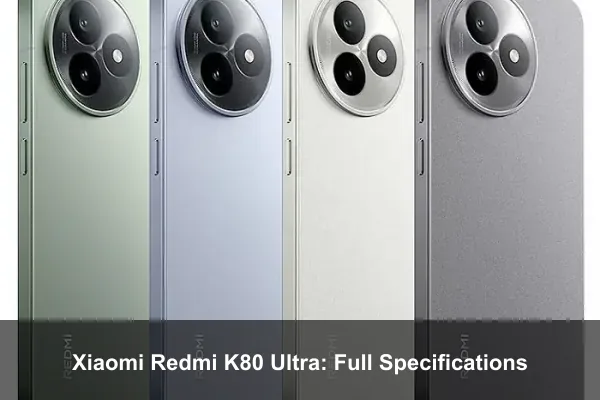
Xiaomi Redmi K80 Ultra is built for buyers who want near-flagship core hardware without stepping into ultra-premium pricing. It combines a premium frame, very fast internals, a high-refresh OLED panel, and a huge silicon-carbon battery.
This guide takes a value-first angle so you can compare it quickly against other phones in its class, focusing on practical strengths, tradeoffs, and the right user profile.
Full Specifications
Network
| Technology | GSM / CDMA / HSPA / CDMA2000 / LTE / 5G |
| 2G bands | GSM 850 / 900 / 1800 / 1900 |
| CDMA 800 | |
| 3G bands | HSDPA 800 / 850 / 900 / 1700(AWS) / 2100 |
| CDMA2000 1x | |
| 4G bands | 1, 3, 4, 5, 7, 8, 18, 19, 26, 28, 34, 38, 39, 40, 41, 42, 48, 66 |
| 5G bands | 1, 3, 5, 7, 8, 26, 28, 38, 40, 41, 48, 66, 77, 78 SA/NSA |
| Speed | HSPA, LTE, 5G |
Launch
| Announced | 2025, June 26 |
| Status | Available. Released 2025, June 26 |
Body
| Dimensions | 163.1 x 77.9 x 8.2 mm (6.42 x 3.07 x 0.32 in) |
| Weight | 219 g (7.72 oz) |
| Build | Glass front, aluminum frame |
| SIM | Nano-SIM + Nano-SIM |
| IP68 dust tight and water resistant (immersible up to 2m for 30 min) |
Display
| Type | OLED, 68B colors, 144Hz, Dolby Vision, HDR10+, HDR Vivid, 1800 nits (HBM), 3200 nits (peak) |
| Size | 6.83 inches, 114.5 cm2 (~90.2% screen-to-body ratio) |
| Resolution | 1280 x 2772 pixels, 19.5:9 ratio (~447 ppi density) |
| Protection | Scratch/drop-resistant glass |
Platform
| OS | Android 15, HyperOS 2 |
| Chipset | Mediatek Dimensity 9400+ (3 nm) |
| CPU | Octa-core (1×3.63 GHz Cortex-X925 & 3×3.3 GHz Cortex-X4 & 4×2.4 GHz Cortex-A720) |
| GPU | Immortalis-G925 |
Memory
| Card slot | No |
| Internal | 256GB 12GB RAM, 256GB 16GB RAM, 512GB 12GB RAM, 512GB 16GB RAM, 1TB 16GB RAM |
| UFS 4.1 |
Main Camera
| Dual | 50 MP, f/1.9, 23mm (wide), 1/1.55", 1.0µm, PDAF, OIS 8 MP, 119˚ (ultrawide), 1/4.0", 1.12µm |
| Features | Color spectrum sensor, Dual-LED dual-tone flash, HDR, panorama |
| Video | 8K@30fps, 4K@30/60fps, 1080p@30/60/120/240/960fps, gyro-EIS |
Selfie camera
| Single | 20 MP, (wide), 1/2.0", 0.8µm |
| Features | HDR |
| Video | 1080p@30/60fps |
Sound
| Loudspeaker | Yes, with stereo speakers |
| 3.5mm jack | No |
| 24-bit/192kHz Hi-Res & Hi-Res Wireless audio |
Comms
| WLAN | Wi-Fi 802.11 a/b/g/n/ac/6/7, dual-band, Wi-Fi Direct |
| Bluetooth | 5.4, A2DP, LE, LHDC 5 |
| Positioning | GPS (L1+L5), BDS (B1I+B1C+B2a+B2b), GALILEO (E1+E5a+E5b), QZSS (L1+L5), NavIC, GLONASS |
| NFC | Yes |
| Infrared port | Yes |
| Radio | Unspecified |
| USB | USB Type-C |
Features
| Sensors | Fingerprint (under display, ultrasonic), accelerometer, gyro, proximity, compass |
Battery
| Type | Si/C Li-Ion 7410 mAh |
| Charging | 100W wired, PD3.0 Bypass charging |
Misc
| Colors | Gray, White, Blue, Green |
| Price | About 310 EUR |
Price and Availability
The Xiaomi Redmi K80 Ultra offers a compelling combination of features and performance. While the base price is around €310, the actual cost may vary depending on your location and retailer. Below, you’ll find the approximate price of the Xiaomi Redmi K80 Ultra converted into various currencies. Please note that these are estimates based on recent exchange rates as of March 29, 2026 and may not reflect the exact price you’ll find at a retailer.
- United States: $357
- Japan: ¥57,150
- United Kingdom: £269
- Australia: A$519
- Canada: C$496
- Taiwan: NT$11,433
- Denmark: kr2.313
- Saudi Arabia: ﷼1,339
- South Korea: ₩538,973
- Germany: €310
- Brazil: R$1.871
- Vietnam: ₫9.389.440
- Kenya: KSh 46,469
- India: ₹33,789
- Indonesia: Rp 6.054.005
- Nigeria: ₦493,307
- Pakistan: ₨99,973
- Philippines: ₱21,612
- Bangladesh: ৳৪৩,৮৫৮
Value and Market Position
At about 310 EUR, the Redmi K80 Ultra stands out by pairing flagship-level processing, UFS 4.1 storage, IP68 protection, and a 144Hz OLED display in one package. Compared with many similarly priced devices, it prioritizes sustained performance and battery endurance over camera variety.
Design and Build Quality
The phone uses a glass front with an aluminum frame, giving it a more premium feel than typical mid-tier builds. At 219 g, it is on the heavier side, but that tradeoff aligns with its large battery and durability target. Dual Nano-SIM support and IP68 water and dust resistance improve everyday practicality.
Display Experience
The 6.83-inch OLED panel is tuned for media and gaming with 144Hz refresh rate support and wide HDR compatibility including Dolby Vision, HDR10+, and HDR Vivid. High brightness figures also make it more usable outdoors, while the high pixel density keeps text and UI elements sharp.
Performance and Storage
The Dimensity 9400+ (3 nm) and Immortalis-G925 GPU place this phone in high-performance territory for gaming, multitasking, and demanding apps. Memory and storage options scale up to 16GB RAM and 1TB, which is useful for long-term use. Since there is no microSD slot, choosing the right internal storage tier at purchase is important.
Camera Focus and Limits
The 50MP main camera with OIS is the clear strength for stable day-to-night shooting and higher-quality primary shots. The 8MP ultrawide is functional for landscape and group framing, but it is not positioned as a premium ultrawide solution. Video capability is strong on paper with up to 8K recording and gyro-EIS support.
Battery and Charging Strategy
A 7410mAh silicon-carbon battery is one of the biggest advantages of this model, especially for gaming and heavy daily use. 100W wired charging keeps refill times short, and bypass charging support is valuable for users who play while plugged in and want better thermal behavior.
Software and Daily Use
Android 15 with HyperOS 2 gives the device a current-generation software base. For users already in Xiaomi services and device ecosystems, the experience should feel consistent and feature-rich, with modern UI behavior and performance tuning aligned to its hardware.
Connectivity and Audio Capabilities
Connectivity is a major strength: broad 5G SA/NSA band support, Wi-Fi 7, Bluetooth 5.4 with LHDC 5, multi-system dual-frequency positioning, NFC, and an infrared port. Stereo speakers and Hi-Res audio support add entertainment value, though there is no 3.5mm headphone jack.
Who Should Buy the Redmi K80 Ultra
This phone is best for power users who rank performance, battery life, and display quality above having a complex multi-camera setup. It is also a strong fit for mobile gamers and heavy streamers. Users who prefer lighter phones or stronger ultrawide camera performance may want alternatives.
Conclusion
The Xiaomi Redmi K80 Ultra is a performance-and-endurance focused choice that delivers unusually strong core specs for its class. If your priority is speed, battery life, and display quality at aggressive value, it is an easy recommendation.
