
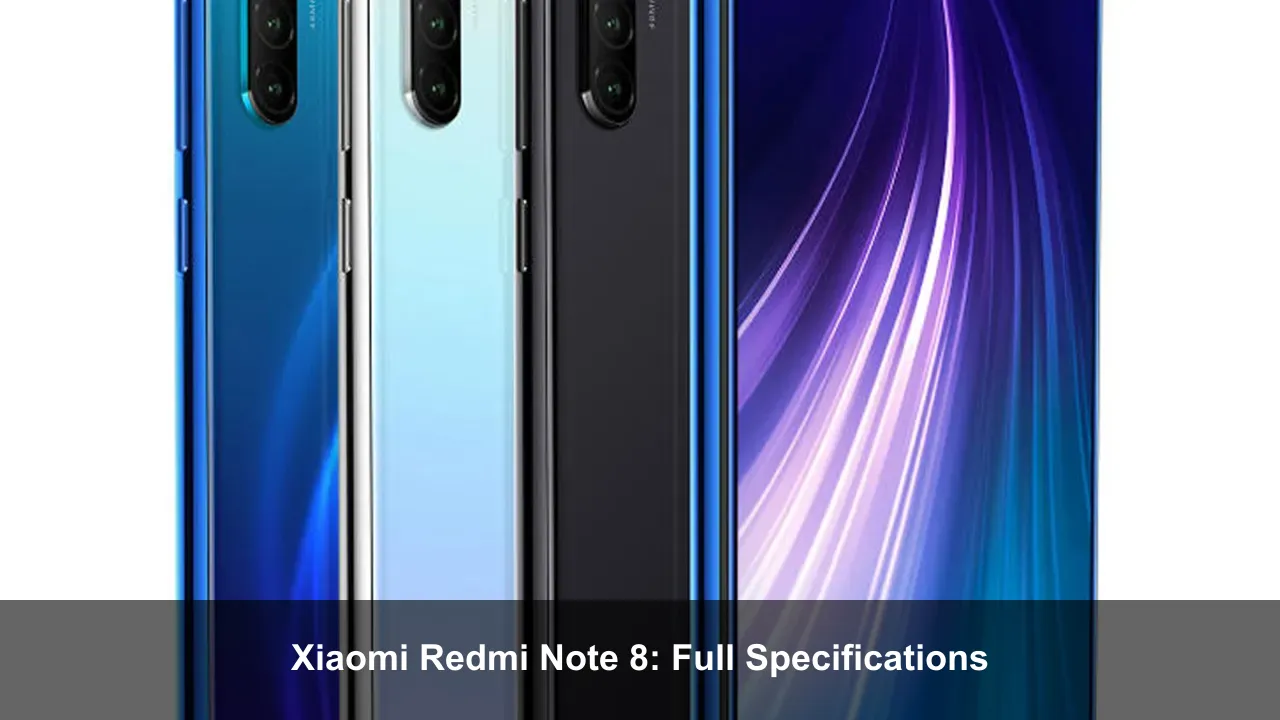
The Xiaomi Redmi Note 8 arrived in late 2019 as a balanced mid-range phone, and it is now a discontinued model mostly found in the used and refurbished market.
Instead of repeating the spec sheet, this article focuses on how its hardware translates to everyday use in 2026 and how it stacks up against newer budget alternatives.
Full Specifications
Network
| Technology | GSM / HSPA / LTE |
| 2G bands | GSM 850 / 900 / 1800 / 1900 |
| 3G bands | HSDPA 850 / 900 / 1700(AWS) / 1900 / 2100 |
| HSDPA 850 / 900 / 2100 | |
| 4G bands | 1, 2, 3, 4, 5, 7, 8, 20, 38, 40 |
| 1, 3, 5, 8, 38, 40, 41 | |
| Speed | HSPA 42.2/5.76 Mbps, LTE (4CA) Cat12 600/50 Mbps |
Launch
| Announced | 2019, August 29. Released 2019, October 16 |
| Status | Discontinued |
Body
| Dimensions | 158.3 x 75.3 x 8.4 mm (6.23 x 2.96 x 0.33 in) |
| Weight | 190 (6.70 oz) |
| Build | Glass front (Gorilla Glass 5), glass back (Gorilla Glass 5), plastic frame |
| SIM | Nano-SIM + Nano-SIM |
Display
| Type | IPS LCD |
| Size | 6.3 inches, 97.4 cm2 (~81.7% screen-to-body ratio) |
| Resolution | 1080 x 2340 pixels, 19.5:9 ratio (~409 ppi density) |
| Protection | Corning Gorilla Glass 5 |
Platform
| OS | Android 9.0 (Pie), upgradable to Android 11, MIUI 12.5 |
| Chipset | Qualcomm SDM665 Snapdragon 665 (11 nm) |
| CPU | Octa-core (4×2.0 GHz Kryo 260 Gold & 4×1.8 GHz Kryo 260 Silver) |
| GPU | Adreno 610 |
Memory
| Card slot | microSDXC (dedicated slot) |
| Internal | 32GB 3GB RAM, 64GB 4GB RAM, 64GB 6GB RAM, 128GB 4GB RAM, 128GB 6GB RAM |
| eMMC 5.1 |
Main Camera
| Quad | 48 MP, f/1.8, 26mm (wide), 1/2.0", 0.8µm, PDAF 8 MP, f/2.2, 120˚ (ultrawide), 1/4.0", 1.12µm 2 MP (macro) Auxiliary lens |
| Features | LED flash, HDR, panorama |
| Video | 4K@30fps, 1080p@30/60/120fps; gyro-EIS |
Selfie camera
| Single | 13 MP, f/2.0, (wide), 1/3.1", 1.12µm |
| Features | HDR, panorama |
| Video | 1080p@30fps |
Sound
| Loudspeaker | Yes |
| 3.5mm jack | Yes |
Comms
| WLAN | Wi-Fi 802.11 a/b/g/n/ac, dual-band, Wi-Fi Direct |
| Bluetooth | 4.2, A2DP, LE |
| Positioning | GPS, GLONASS, BDS |
| NFC | No |
| Infrared port | Yes |
| Radio | FM radio |
| USB | USB Type-C 2.0, OTG |
Features
| Sensors | Fingerprint (rear-mounted), accelerometer, gyro, proximity, compass |
Battery
| Type | Li-Po 4000 mAh, non-removable |
| Charging | 18W wired |
Misc
| Colors | Neptune Blue, Moonlight White, Space Black, Nebula Purple, Cosmic Purple |
| Models | M1908C3JH, M1908C3JG, M1908C3JI |
| SAR | 0.26 W/kg (head) 1.00 W/kg (body) |
| SAR EU | 0.19 W/kg (head) 1.09 W/kg (body) |
| Price | About 220 EUR |
Our Tests
| Performance | AnTuTu: 141915 (v7), 161572 (v8) GeekBench: 5590 (v4.4), 1339 (v5.1) GFXBench: 5.9fps (ES 3.1 onscreen) |
| Display | Contrast ratio: 1521:1 (nominal) |
| Camera | Photo / Video |
| Loudspeaker | Voice 78dB / Noise 72dB / Ring 81dB |
| Audio quality | Noise -94.0dB / Crosstalk -93.3dB |
| Battery (old) | Endurance rating 108h |
Price and Availability
The Xiaomi Redmi Note 8 offers a compelling combination of features and performance. While the base price is around €220, the actual cost may vary depending on your location and retailer. Below, you’ll find the approximate price of the Xiaomi Redmi Note 8 converted into various currencies. Please note that these are estimates based on recent exchange rates as of March 20, 2026 and may not reflect the exact price you’ll find at a retailer.
- United States: $254
- Japan: ¥40,195
- United Kingdom: £190
- Australia: A$360
- Canada: C$349
- Taiwan: NT$8,096
- Denmark: kr1.642
- Saudi Arabia: ﷼952
- South Korea: ₩379,525
- Germany: €220
- Brazil: R$1.333
- Vietnam: ₫6.582.093
- Kenya: KSh 32,806
- India: ₹23,588
- Indonesia: Rp 4.302.034
- Nigeria: ₦343,029
- Pakistan: ₨71,083
- Philippines: ₱15,224
- Bangladesh: ৳৩১,২০১
Value Position in 2026
The Redmi Note 8 launched at around 220 EUR, but its relevance today is tied to used-market pricing. If it is significantly cheaper than current entry 4G models, it still delivers good core value with a sharp display and practical hardware features.
Design and Build Quality
With Gorilla Glass 5 on both front and back, the phone still feels more premium than many plastic budget devices. The plastic frame keeps costs down, while the rear fingerprint scanner remains reliable and easy to use.
Display Experience
The 6.3-inch Full HD+ IPS panel is a highlight for this class, especially for text clarity and video detail. It lacks high refresh rate smoothness, but its pixel density gives it an advantage over many lower-resolution budget screens.
Performance for Daily Use
Snapdragon 665 performance is still adequate for messaging, social apps, navigation, and streaming. It is less convincing for heavy gaming or demanding multitasking, so higher RAM variants are the better long-term choice.
Camera Practicality
The 48 MP main camera can still produce solid daylight images, and the ultrawide adds flexibility for landscape shots. The lower-resolution secondary sensors are limited, and low-light quality shows the phone’s age compared with newer mid-range cameras.
Battery Life and Charging
A 4000 mAh battery remains acceptable for full-day moderate use, and historical endurance testing was strong for its class. The main drawback is 18W charging, which feels slow next to newer devices offering much faster refill times.
Software Longevity
Software is the biggest compromise: the phone tops out at Android 11 with MIUI 12.5. It can still run everyday apps, but long-term update confidence and modern Android feature support are clearly behind current releases.
Connectivity and Useful Extras
The feature set is practical for budget buyers: dual SIM, dedicated microSD slot, 3.5 mm jack, USB-C with OTG, infrared port, and FM radio. Trade-offs include no NFC, older Bluetooth 4.2, and no 5G support.
Who Should Buy the Redmi Note 8?
This phone makes sense for users who want a low-cost backup device, a starter smartphone, or a media phone with expandable storage and a headphone jack. Buyers who prioritize long software support, NFC payments, or future-proof networking should look at newer models.
Conclusion
The Xiaomi Redmi Note 8 is still a practical budget option only when priced aggressively in the used market, with strengths in basics but clear limits in software lifespan and modern connectivity.
